
 |
 |
| Digital slideshow customized with Smilebox |

|
|
| Digital slideshow customized with Smilebox |
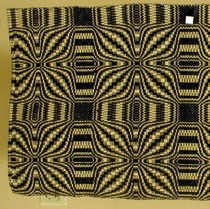
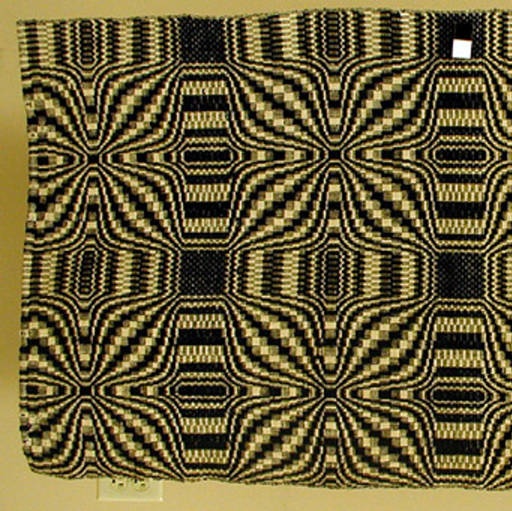 An old pattern in overshot weaving that has had many names over time: Muscadine Hills, Hickory Leaf, Blooming Leaf. The Double Bow Knot name comes from the leaf like square that forms the larger portion of the design. The dark square is called a table. Because there are two motifs used the pattern it may be most properly described as a Double Bow Knot and table design.
This design can be woven with only four shafts in an overshot structure. Overshot blocks can share shafts, which is what makes them so efficient. It is a structure that will require you to have planned your design carefully before you thread your loom. The threading typically is the most limiting design factor. 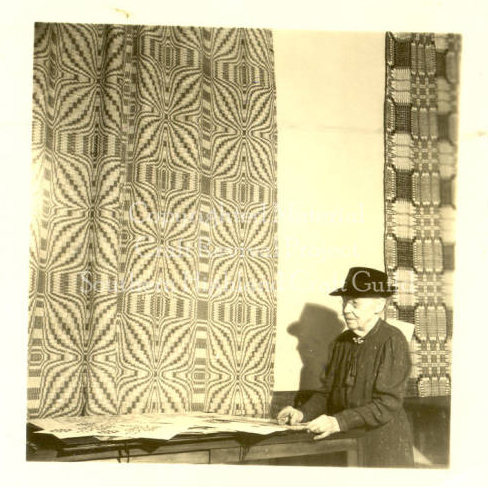
The goal of traditional overshot weaving is to be able to “square” the blocks as they are woven from the lower right hand corner of the loom to the left most block, which will result in the leaf or bow portions being square also. The coverlet in the photo on the right was not a perfect square and did not “match” when sewn together. This could be from the choice of threads for pattern and weft, and it may also have been impacted by how tightly it was beaten when woven.
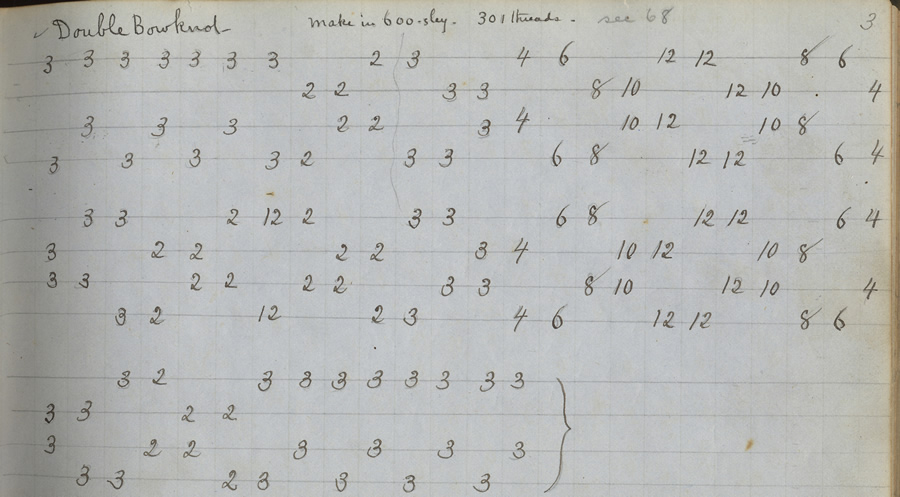 Early copies of drafts for this coverlet were written with a different notation than weavers use today.
 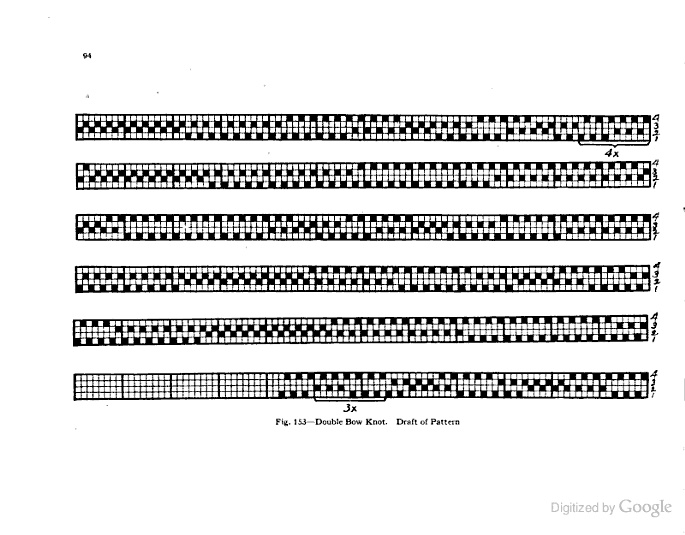 The only threads listed were pattern threads. Weavers were expected to know where the plain weave threads were to be placed. The draft to the right is a modern version of the draft on the left. All of the needed threads are shown for the pattern. It is read from right to left and top to bottom. What it does not tell you is anything about the needed tie-up or the treadling.
Not to despair, these early weavers knew some basic weaving information that may not be apparent to weavers today. If you look closely that the draft above on the right, every other thread appears on either the first or second shaft, this is our clue as to where the plain weave background will come from. The first treadle will need to be tied to shafts 1 and 2 and the second treadle will be tied to shafts 3 and 4. When you alternate these using treadles you will achieve a plain “tabby” weave. When translating a historic pattern I suggest simplifying it into a profile draft to demonstrate the order and number of blocks that must be threaded on the loom. When you do this you can now use any block structure you would like.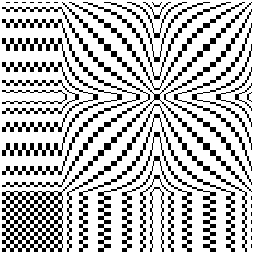 This design can be woven using any loom that can support 4 blocks of the desired structure. This pattern in overshot will require 744 threads. If sett at 24 threads per inch a single repeat will be 31 inches wide when woven. In the photo of the full coverlet above the coverlet was woven with 2 and 1/2 repeats in each piece. The documentation for the coverlet indicates it was sett at 40 ends per inch (epi). It would have likely to have been woven on a 60″ wide loom.
This profile could be woven as:
There are a ton of possibilities based on your choice of profile and structure, we haven’t even begun to talk color, or choice of materials.
Because of the large size of the profile draft, it is not expected that the coverlet will require a border. The table portion of the design can function as a border if it is placed on both sides of the warp.
Primary Weaving Resources:
Additional Weaving Resources: (Use Resources search page for a complete listing)
Drafting Files for Download:

Download a Profile Draft to use in your weaving software

Download the FULL Weaving Draft to use in your weaving software. File is in ZIP format.
Download a Zipped (Compressed) file with the Full Draft images of threading, treadling, and tie-up. Does not require you to have weaving software.

Download a Double Bow Knot Shawl Project. Package includes a PDF file